无间道三
上海:加快具身智能技术熟化 加强智能机器人自主全产业链布局_我的网站

A |
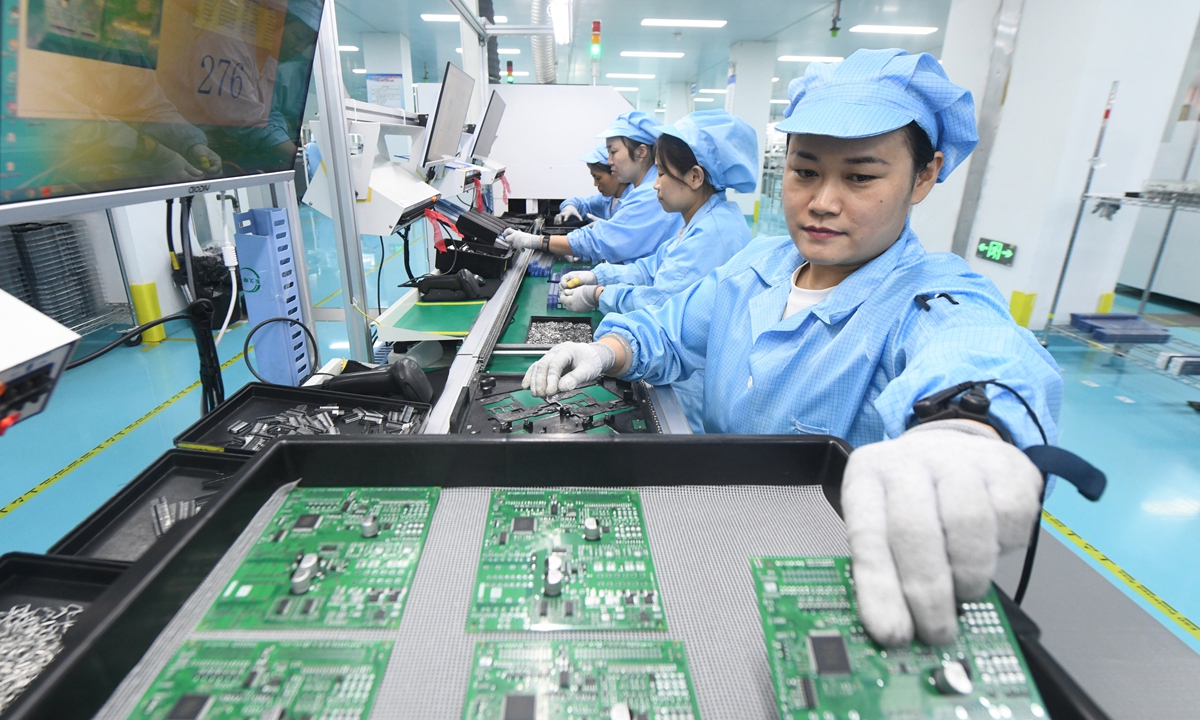
Workers produce electronic components for exports at a factory in Xinle, North China's Hebei Province, on June 16, 2026. Photo: VCG
China's exports of integrated circuits (ICs) reached $216.02 billion in the first seven months of 2026, up 99.5 percent year-on-year, according to data released by the General Administration of Customs (GAC) on Friday.
Chinese experts said that rising global artificial intelligence (AI) demand is a factor, but the main drivers of the leap in chip exports are the country's technological breakthroughs and upgraded industrial chain.
The robust growth in IC exports also came as China's overall foreign trade saw stable expansion. According to data released by the GAC, the sound upward trend in China's foreign trade continued in July, with growth of 19.2 percent year-on-year to reach 4.66 trillion yuan ($686.26 billion), remaining above 4 trillion yuan for the fifth consecutive month.
In the first seven months of the year, total foreign trade in goods amounted to 30.13 trillion yuan, up 17.3 percent year-on-year, the data showed.
"Since the start of this year, China's economy has forged ahead against headwinds and moved toward innovation-driven, higher-quality development, providing strong underpinning for the growth of foreign trade," said Lü Daliang, an official with the GAC.
According to the GAC, China's exports of electromechanical products reached 11.12 trillion yuan between January and July, up 21.2 percent year-on-year. They accounted for 63.8 percent of the country's total exports, up 3.8 percentage points on a yearly basis.
There was notable progress in green and low-carbon products, with exports of electric vehicles (EVs) and lithium batteries rising by 71.2 percent and 35.8 percent, respectively, while exports of 3D printers soared by 110 percent, with industrial robots jumping 13.2 percent and ships 32.7 percent.
"The surge in China's chip exports reflects breakthroughs in multiple aspects," Fu Liang, a Beijing-based tech analyst, told the Global Times on Friday. Fu pointed to a rise in mature-node capacity, industrial and supply chain resilience, and scale production advantages of Chinese companies.
As demand for chips in automotive electronics, industrial control systems, and household appliances keeps rising, China-made mature-process chips - backed by reliable supply capability and strong cost-performance - have become an indispensable link in the global supply chain, Fu said.
Meanwhile, there has been an upgrade in China's chipmaking industry, such as the new chip design approach at Huawei based on the company's Tau Scaling Law, and the international competitiveness of China-made chips is expected to increase, supporting further growth in exports, the expert noted.
China recently issued a revised regulation on protection of IC layout-designs. Scheduled to take effect on October 15 this year, the regulation aims to strengthen the protection and application of layout-designs, and improve registration and management systems by elevating proven practices into regulations, while also aligning with relevant laws and international treaties.
These institutional upgrades are unfolding alongside broader efforts to expand domestic demand and open the Chinese market wider to the world. China has also accelerated imports in the first seven months of this year to promote a more balanced development of foreign trade. China has remained the world's second-largest import market for 17 consecutive years. In the first seven months of 2026, China's import growth outpaced export growth by 8 percentage points, according to the GAC.
In addition, China's imports and exports with over 180 countries and regions registered growth over the period. Specifically, the country's trade with ASEAN, the EU, Latin America, and Africa rose by 20 percent, 9.5 percent, 15.4 percent, and 18.9 percent year-on-year, respectively. Trade with the US, however, fell by 1.6 percent, with the decline narrowing by 2 percentage points compared with the first half of the year, according to the GAC.
Amid a complex external environment, China has leveraged its complete industrial chain to accelerate trade structure upgrading, driving brisk growth in both imports and exports, Wen Bin, chief economist of China Minsheng Bank, told the Global Times.
Although China's foreign trade sector still faces pressure in the second half of the year, Wen said the same fundamentals are still supporting China's export growth: the competitiveness of China's "new new three" products, the ongoing AI investment cycle, plus a raft of domestic risk-mitigation policies covering forex, fiscal and customs.
"China's export sector is projected to hold onto double-digit growth in the second half of the year," he said.
。 上海:加快具身智能技术熟化加强智能机器人自主全产业链布局
人民财讯8月24日电,上海市人民政府印发《上海市加快推进新型工业化构建现代化产业体系“十五五”规划》。其中提到,全面提升智能计算能力,攻关高性能、低功耗、高效率的智算芯片,提升集群组网和云服务能力,探索异构计算、光计算、量子人工智能等创新架构;优化智算基础设施,构建城市算力网络。持续发力大模型,聚焦下一代大模型研发,攻克架构设计、训练优化等关键技术,推动芯片、大模型、智算云协同发展,构建自主生态。深入推进“模力聚申”行动,加快具身智能技术熟化,加强智能机器人自主全产业链布局,提升关键环节性能,推动在工业制造、物流装配、商业零售、医疗康养、家政服务等重点领域实景应用。 。
Current article:http://rueyhq.shengyaodanrongchui.buzz/unsts/bqub0.html
Published on:18:53:36

 Bhagalpur News: बांका में होगी सिपाहियों की ट्रेनिंग, भागलपुर व नवगछिया को भी होगा फायदा
 ZOL科技早餐:华为mate50系列5G手机壳曝光,18GB+1TB版手机打折直降_iPhone_Pro
 美方称敦促中国配合针对伊朗的经济制裁 中方回应
 哈利波特的魔法:自动行走的国际象棋表演
 Edmunds recommends the five best SUVs for under $40K
 原创 游历雅记:又见琴岛
 谷歌杀入法律 AI 赛道,推出专用 Gemini 工具
 Tech exchange drives China-Cambodia industrial cooperation at Phnom Penh machinery show


